"I see myself as a builder — from idea to market"
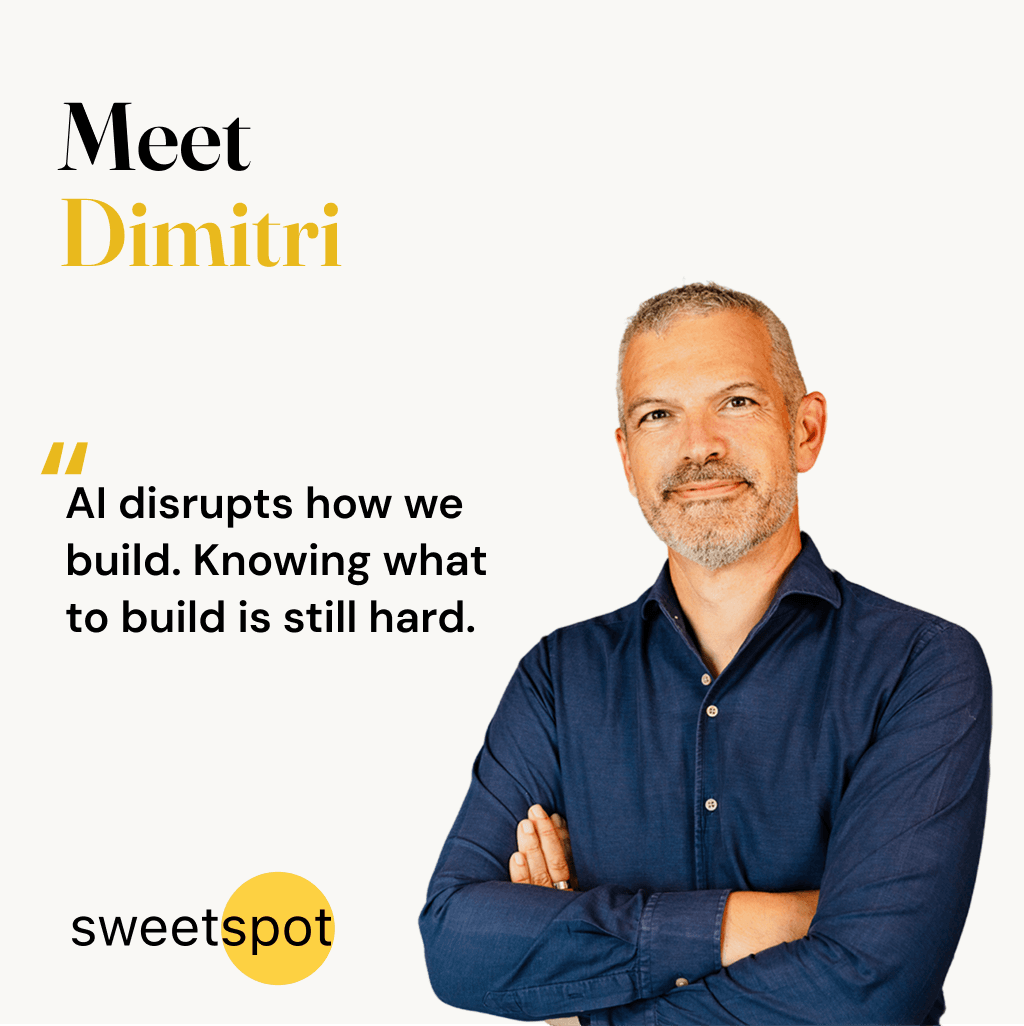
A conversation with Dimitri, founding partner at Sweetspot
Dimitri doesn't fit neatly into a box. Over the course of almost 30 years, he's been a software engineer, product manager, head of product management, CTO, and managing director — sometimes all at once. Today, as a founding partner at Sweetspot, he brings that cross-functional depth to companies wrestling with complex B2B products. We sat down with him to talk about his career, his working style, and why he thinks most companies are solving the wrong problem.
Your career spans software engineering, product management, and business leadership. What's the common thread?
Products. Complex solutions, to be more precise, and always B2B. That has been the red thread throughout everything I've done. I see myself more as a builder of solutions: from idea to actually building it and bringing it to market. Cross-functional, with everything that comes with it. How do you maintain the value of a solution in the market? How do you price it, sell it, service it, deploy it? Those questions have followed me across every role.
How did that journey unfold?
I started in software development at Barco in 1997. From there, each role pulled me further across the value chain — from engineering to product management, to head of product, to CTO, to managing director with P&L and a team of 90 across four countries. I didn't just manage products. I've helped run the businesses behind them.
Two years ago I co-founded Sweetspot with Koen and Ronny. The original idea was: to do something around the cross-functional gap I kept seeing in companies — things going wrong precisely because no one was looking at the full picture.
What does cross-functional actually mean in practice at Sweetspot?
Most agencies or consultancies are vertically oriented. They are technical specialists, product specialists, innovation specialists, marketing specialists. That works well for isolated problems. But companies are dynamic systems. Their problems are rarely isolated to one team or one discipline; they're almost always linked.
We come in from a product angle, but we can equally think about your business strategy, your business model, your go-to-market. And we don't just give advice and leave. We try to work in phases, stay involved, and contribute to actually building the solution. We're fractional, not interim — that's an important distinction. You're also not just getting one person: you get the combined thinking of the whole team. We brief each other continuously, so there's always a broader sounding board available.
What's your personal superpower — the thing you bring that others don't?
Connecting the dots. I can see patterns across domains relatively quickly and build a strategy around them. I'm also reasonably good at communicating complex things clearly, also visually. That combination of seeing the big picture and being able to translate it into something tangible has been central to every role I've had.
I'm a generalist, not the deepest specialist in any one area, except for product management. But I can move across domains, spot where the real problem is, and formulate a path forward. That breadth is what makes me useful at the intersection of technology, product, and business.
You're back to coding. What's driving that?
I've always wanted to be able to build things myself, from idea to working product, without depending on a team. But since moving into management roles around 2010, it's been hard to stay hands-on with code and sustain it. Now, with tools like Claude Code, the barrier to building has dropped dramatically. I'm actually making things again, and I find that incredibly energizing.
It also keeps me sharp. I follow technology closely — probably one to two hours a day — and being hands-on with code means I'm not just reading about how AI is reshaping software development, I'm experiencing it directly. That matters for the clients I work with. If you want to advise on product or technology direction, you need to feel where the real shifts are happening.
What do people get wrong about you?
I'm not someone who enjoys small talk — but put me in a conversation about technology, product, history, or geopolitics, and I can go for hours. I'm also very goal-oriented in meetings. I want to get to the point, make a decision, and move on. That means my conversation style is direct and assertive. That's not always comfortable for everyone, but it's what makes me useful in complex situations where things have been going in circles for too long.
What gets you genuinely excited about your work?
Helping to solve a real problem. And not just advising on it, but actually contributing to the solution. The creative part. When there's a messy situation, and we can bring structure to it, sharpen the thinking, and see something click into place; that's when I'm most energized. Building things that matter. That's really what drives me.
Want to explore what Dimitri and the Sweetspot team could do for your product? Book a quick intro call with him.