"Make every word count."
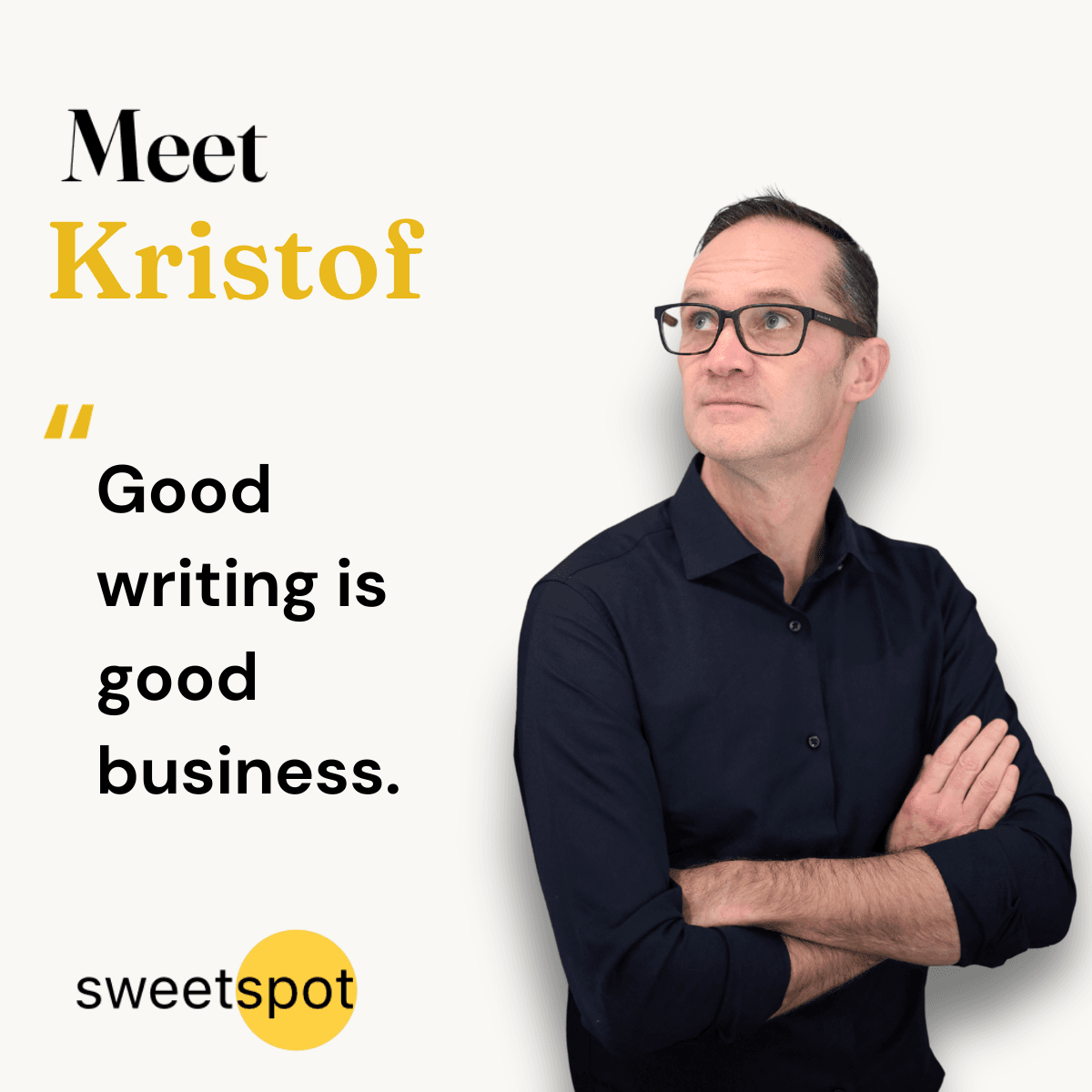
A conversation with Kristof Maddelein, storyteller and product marketer at Sweetspot
Kristof has spent his career at the intersection of two things that don't always get along: language and technology. He's a copywriter by experience and by instinct, someone who makes every word count. But he's also been drawn, for as long as he can remember, to the restless human drive to build, improve, and reinvent. At Sweetspot, those two threads come together naturally.
Your career has followed two very different tracks. How does that work?
It really has. There's the track of language. Writing has gone from being my job to being a genuine passion. I'm a copywriter at heart, a man of words. That means you're in a constant conversation with yourself: does this sentence say what I mean? Can I put it better, more precisely, more convincingly? Make every word count, that's still my working principle.
Then there's technology. I've always been fascinated by what you might call human inventiveness, the fact that people never quite accept the world as it is. Technology, in the deepest sense, is that drive made visible. Yes, it often comes down to being faster or more productive. But underneath that is something more interesting: the refusal to accept the status quo.
What I love most is helping technology companies move forward with strong marketing. If I had to reduce it to one sentence – and I'm not usually a fan of mission statements — it would be that.
Make every word count, that's still my working principle.
Is copywriting really a strategic discipline, or is it execution?
Copywriting is marketing. Full stop. In the ideal world, you don't write a single word before you understand a company's value proposition, before you know how it differentiates itself, who the customer is, what language they use. Good copywriters run discovery processes. They think about positioning. They're not people who sit down and write pretty sentences.
The confusion comes from the output. Because what you see at the end is a text, people assume that's all there was. But there's a lot of thinking that has to happen before the writing starts. Ultimately, good writing is good business.
When does a marketing problem turn out to be a company problem?
Often. Good copy can amplify a good product, but it can’t rescue a weak one. However brilliant your copy, however beautiful your website, if the underlying product or story isn't solid, you're carrying water to the sea. I've written plenty of copy for products that seemed extraordinary in the mind of the engineer who built them, but didn't survive first contact with a real customer.
That's actually one of the reasons I find Sweetspot interesting. The work here starts upstream, before the writing, before the campaign. With product strategy, positioning, figuring out whether the story even holds up. That's where the real leverage is.
What does finding a unique story actually require?
The most reliable path is to talk to your customers. Not enough companies do this. What your customers value about you is almost never exactly what you think they value. And you need to know your competition, obviously. But above all, you need the willingness to examine yourself honestly, to step away from how you've always thought about what you do.
Most companies are sitting on a compelling story without knowing it. It lives with the people who are closest to the work, the most passionate ones, the ones who can't stop talking about what they're building. Your job as a storyteller is to find them and listen.
The most reliable path to finding your story is to talk to your customers. Not enough companies do this.
What gives you energy in your work?
Conversations with smart people, and the challenge of translating complex technology into something that genuinely makes sense to a customer. A value proposition, a website text, a thought leadership piece, they're all versions of the same puzzle. You're unfolding a map piece by piece until suddenly the route becomes clear. That moment, when it clicks, is what I'm in it for.
How do you think about AI, as someone who works with language for a living?
With a mix of genuine enthusiasm and genuine skepticism. And I'll be honest: at first it was confronting. To watch something that felt like a craft — because that's what writing is — be executed almost perfectly by a machine. We shouldn't pretend that's not happening. The job of the copywriter, the marketer, will never be the same.
My first job was as a language specialist at Lernout & Hauspie, the speech technology company, West Flanders' great pride in the late nineties. I remember the excitement when speech recognition systems hit 98% accuracy. But that last 2% made an enormous practical difference. A system that mishears a critical word at the wrong moment isn't 98% useful; it's a liability. I often think about AI the same way today.
But it's not AI or the human. It's AI and the human. What I find genuinely interesting is using AI in ways that make my work better, not just faster.
As for the role of humans in the age of AI, there’s an interesting interview on YouTube with Rick Rubin, producer of records by Slayer, Red Hot Chili Peppers, and Johnny Cash, where Rubin points out that he has no technical skills whatsoever. When the interviewer asks Rubin what he's actually being paid for, the answer is: “the confidence I have in my taste, and my ability to express what I feel.” That says everything.
Who do you look up to professionally?
More people than I can name. On the marketing side: Doug Kessler from Velocity Partners, Ann Handley, Cole Schafer, Ed Gandia. People who have thought seriously about what good looks like in this field.
Outside of marketing, I admire people who are curious and carve their own path, like author Ryan Holiday, Basecamp founder Jason Fried, or Bruce Dickinson, singer of Iron Maiden but also an entrepreneur, commercial airline pilot, and fencer. People whose curiosity and energy I find genuinely inspiring.
What made you want to work with Sweetspot?
The people. The down-to-earth culture. And maybe also the fact that at this level of seniority, we're not easily seduced by hype. We can see the essence of a problem without getting distracted by whatever is fashionable that quarter.
AI has made it easier than ever to build a software product. Which means it's more important than ever to think hard about everything around the product: the value proposition, the target audience, the story that makes it matter. To use a cycling analogy: building products has become a mass sprint. To win, you need to be a Jasper Philipsen. But no sprinter wins without a lead-out man, someone who pulls the sprint open and delivers him to the line. That's what Sweetspot is good at. My expertise fits in as a complement.
Building products has become a mass sprint. To win, you need to be a Jasper Philipsen. And every Philipsen needs his lead-out. That's Sweetspot.
What do you do when you're not working?
I’m a husband and a father. A music buff who listens to everything from jazz to metal. I play keyboards in a funk band with a few friends. I read obsessively, and I hope to finish my own novel one day. More interests than I can handle.
Want to explore what Kristof and the Sweetspot team could do for your product story? Book a quick intro call with him.